The weekend sourcer
You have a day job and you hit the clearance aisles on Saturday. You need to know in the time it takes to pick something up whether it makes money after FBA fees — not after you have already bought sixty of them.
Minnow is the smallest net we make, and it exists for exactly one reason: to prove the model works before you spend real money scaling it. One Amazon account, one seller, and the two tools that decide whether a deal is worth buying.
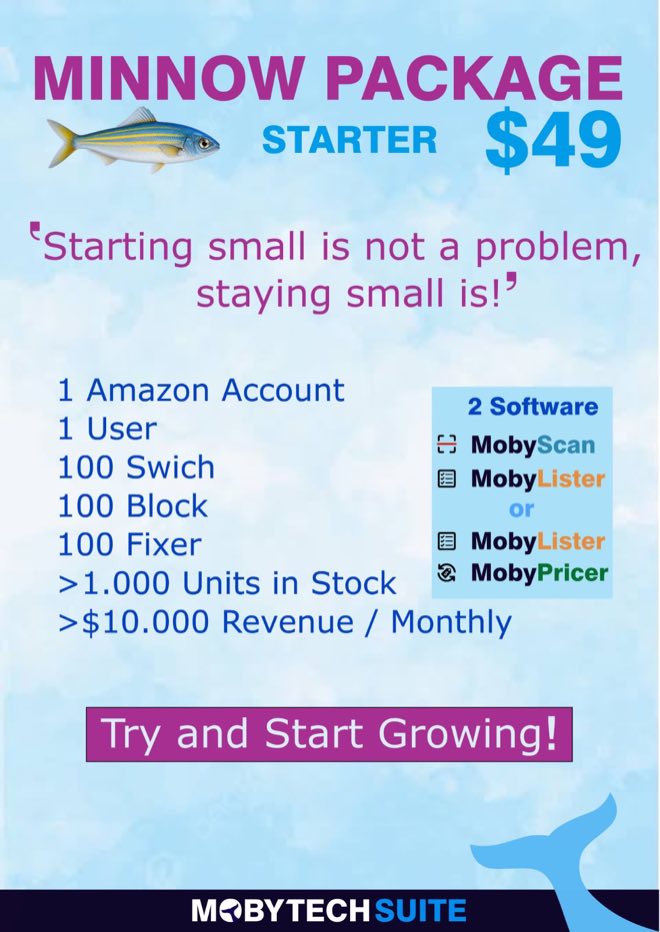
“Starting small is not a problem, staying small is!”

The moment the guessing has to stop — when you need numbers in your hand in the aisle, not a post-mortem in a spreadsheet on Sunday night.
You have a day job and you hit the clearance aisles on Saturday. You need to know in the time it takes to pick something up whether it makes money after FBA fees — not after you have already bought sixty of them.
Your cost basis lives in a workbook, your listings live in Seller Central, and neither knows the other exists. Minnow ends the copy-paste without asking you to change how you work.
You have read the horror stories — repricers racing to the bottom, returns eating a month of margin. You want the whole loop tested on a small catalogue before you bet anything serious on it.
You are already running a second Amazon account, you need someone else in the tool with you, or you are past $10K a month. At that point Minnow is a ceiling rather than a floor, and Anchovy starts exactly where Minnow ends. Look at Anchovy instead →
Every Minnow includes the scanner. The second seat at the table is yours to pick — and the right answer depends entirely on where your month is actually getting stuck.
Scan a barcode in the aisle and see landed profit, FBA fees and sales rank before the item goes in your cart.
Turn a UPC or ASIN into a live Amazon listing — condition notes, templates and FNSKU labels included.
Rule-based repricing inside a floor and a ceiling you set. It chases the Buy Box against the seller types you choose and stops rather than selling under your margin.
If listing is what eats your evenings, take MobyLister. If you already have stock sitting and your Buy Box share is the number that hurts, take MobyPricer. And if the honest answer is “both” — that is Anchovy, and it is only $50 more.
The same figures that appear on the printed sheet — nothing rounded up for the website.
| Limit | Standard |
|---|---|
| Amazon accounts | 1 |
| Users | 1 |
| Included tools | MobyScan + 1 choice |
| Switch operations | 100 |
| Block operations | 100 |
| Fixer operations | 100 |
| Monthly turnover | $10K |
| Stock items | 1,000 |
| API access | — |
| PRO tier | — |
| Phone & email support | ✓ |
Not a feature list — the actual shape of a sourcing weekend once the tool is doing the arithmetic.
You pick something off a clearance endcap and scan the barcode. Landed profit after FBA fees, the current Buy Box price and the sales rank land on one screen. You buy it or you put it back, and either way the decision was made in the aisle.
MobyScanNo signal behind the stockroom wall. The scanner keeps working from its local database and the scans queue quietly, syncing the moment you walk back into a bar of coverage.
MobyScanYesterday’s haul goes live. UPC in, condition note applied from a template, FNSKU label printed. The pile in the hallway becomes a catalogue.
MobyListerYour rules run without you. Prices move inside the floor and ceiling you set, and nothing sells below the number you decided was worth getting out of bed for.
MobyPricerOne account, 1,000 items, $10K through the door. When you start pressing against those figures, Minnow has done its job: you now know the model works, and you know exactly what to scale.
Starting small is not a problem, staying small is!
That line is printed on the Minnow sheet. Every limit on this page comes from it — nothing was rounded up for the website.
A profit calculator in one window, a listing tool in another and a spreadsheet that reconciles neither — replaced by one place where the numbers already agree with each other.
Minnow is one shape on purpose. Nothing to compare on day one, nothing to be upsold into before you have even proved the model works.
Roughly where a side business becomes a business. Hitting that ceiling is not a wall — it is the signal that you have earned the next plan.
The things sellers ask us before they commit to this plan specifically.
Tell our McKinney, TX team your monthly turnover, SKU count and headcount. Fifteen minutes is usually enough to know whether Minnow is the right size — including when the honest answer is no.
Talk to us 214 214 MOBYAsk which one is costing you money right now. If unlisted stock is piling up, MobyLister clears the backlog. If your stock is already live and the Buy Box keeps slipping away, MobyPricer defends the margin. Listing bottlenecks are the more common answer for a first plan.
You are not stuck with it. Moving up to Anchovy gives you MobyScan, MobyLister and MobyPricer together for $99, and your catalogue, cost data and settings carry straight over.
No. Minnow is Standard only — the PRO tiers start at Anchovy. That is intentional: at this size a second tier would just be a decision you do not have enough data to make yet.
Nothing switches off mid-month. You will see the limit approaching in your dashboard and we will point you at the plan that matches your new volume.
Not on Minnow — it is a single seat. Anchovy gives you two, and five on the PRO tier, each with their own login instead of a shared password.
No. MobyScan works with your phone camera on day one. Most sellers add a Bluetooth ring scanner and a Rollo or Dymo thermal printer once the volume justifies it, and both are supported when you get there.
Yes. MobyScan keeps a local product database on the device, so lookups stay fast in dead zones and everything syncs when you are back online.
These are the automated actions your rules can take, and every plan includes a monthly allowance of them — 100 each on Minnow, rising to 5,000 on Whale. Running out regularly is a sign to move up a plan rather than a reason for anything to stop.
All five run on the same Core Suite and the same shared record. What changes is how many Amazon accounts, seats and units you get — and moving between them later costs you nothing but the price difference.

Start your free trial, or tell us your numbers and we will say honestly whether Minnow is the right size.