Call us: 214 214 MOBY (6629) Built in McKinney, TX — for Amazon sellers everywhere
SmartMost chosen

Dolphin

Dolphin Package · Smart

Dolphin is the plan most sellers settle on, because it is the first one where stock stops being guesswork. MobyShelf joins the loop, an API connection opens the door to the systems you already run, and the ceilings stop being something you think about every month.

$299$399/monthStandardPRO tier

Standard $299/month · PRO $399/month

“The month you stop finding out about stranded stock from Amazon.”
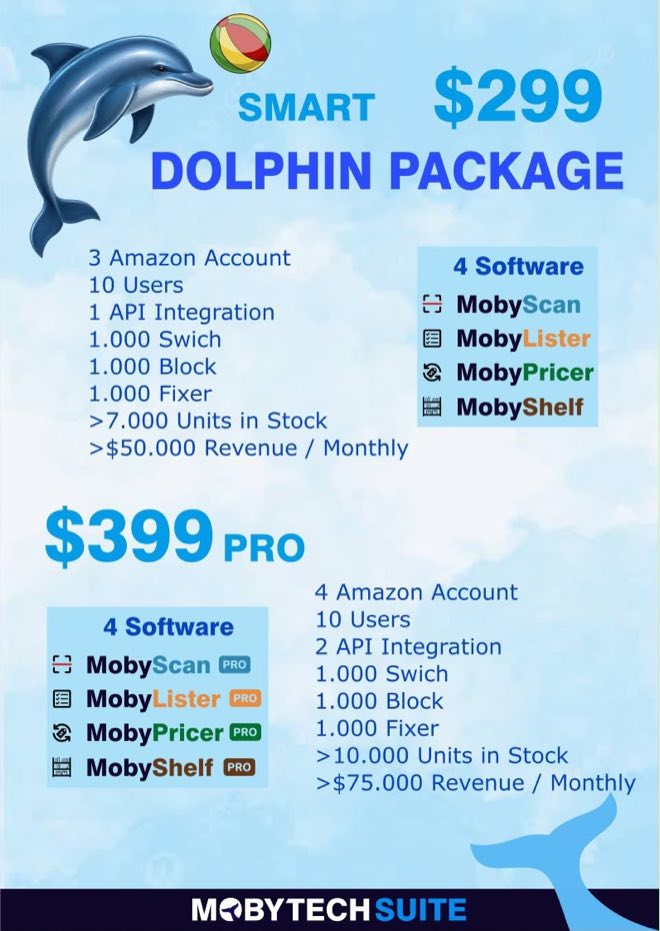
Dolphin package sheet
The Dolphin package sheet
Dolphin mascot
34Amazon accounts
10Users
12API connections
$50K$75KMonthly turnover
7,00010,000Stock items

Dolphin is where the problem changes shape

Sourcing works. Listing works. What hurts now is not knowing what you actually have, where it is, and how fast it is moving.

01

Stock is the problem now

You have been stranded, you have oversold, and you have sat on inventory that quietly aged past the point of profit. MobyShelf is the tool that makes those three sentences stop happening.

02

A team of about ten

Ten seats on both tiers — sourcers, listers, a warehouse hand and whoever does your numbers, all inside the same catalogue instead of the same email thread.

03

You already run your own systems

A warehouse system, a BI dashboard, an accounting package you are not about to abandon. Dolphin is the first plan with an API connection, so the suite feeds them instead of competing with them.

Dolphin is probably not your plan if…

What is actually keeping you up is the payout reconciliation — settlement reports, profit per SKU, a bookkeeper waiting on you every month. That is MobyPoint, and it arrives with Octopus. Look at Octopus instead →

Four tools, and the loop finally closes

Scan, list and reprice were about getting product out of the door. MobyShelf is about knowing what is behind it.

MobyScan Included

Scan a barcode in the aisle and see landed profit, FBA fees and sales rank before the item goes in your cart.

In DolphinThe buy decision, with the fee maths already done.

MobyLister Included

Turn a UPC or ASIN into a live Amazon listing — condition notes, templates and FNSKU labels included.

In DolphinBulk listing, templates and labels — the backlog stays cleared.

MobyPricer Included

Rule-based repricing inside a floor and a ceiling you set. It chases the Buy Box against the seller types you choose and stops rather than selling under your margin.

In DolphinBuy Box competition inside the floor you set.

MobyShelf New at this plan

One stock ledger across warehouses and channels — restock forecasts, ageing stock and stranded inventory surfaced before Amazon tells you.

In DolphinRestock forecasts from real velocity, ageing and stranded stock flagged early, and one stock number that every tool agrees on.
Why Shelf changes the arithmetic

An oversell costs you a metric hit and a refund. Stranded inventory costs you storage on something that cannot sell. Guessing a restock costs you either a stockout or a warehouse full of capital. Dolphin is the plan where all three stop being guesses — which is usually why sellers stop shopping here.

Every limit, in one table

The same figures that appear on the printed sheet — nothing rounded up for the website.

LimitStandardPRO
Amazon accounts34
Users1010
Included toolsScan · Lister · Pricer · ShelfSame four, PRO grade
API connections12
Switch operations1,0001,000
Block operations1,0001,000
Fixer operations1,0001,000
Monthly turnover$50K$75K
Stock items7,00010,000
Phone & email support✓✓

A week on Dolphin

The same loop as Anchovy, with the part that used to be improvised replaced by numbers.

01

Monday — the restock list writes itself

Instead of walking the shelves and guessing, you open a restock forecast built from actual sales velocity. What is about to run out is at the top, and what is quietly dying is flagged at the bottom.

MobyShelf
02

Tuesday — buying against a plan

You source with the list in your pocket. The scanner still judges every deal on landed profit, but now it also knows whether you already own eleven of that thing in a box in the back.

MobyScan · MobyShelf
03

Wednesday — three accounts, one screen

Three storefronts on Standard and four on PRO, reporting into one catalogue view. Nobody adds up two dashboards by hand any more.

Multi-account
04

Thursday — the API earns its keep

Your own dashboard pulls stock and sales through the API connection, so the numbers your accountant sees and the numbers your warehouse sees are finally the same numbers.

API access
05

Friday — nothing was stranded

No oversell, no listing quietly suppressed, no pallet of stock discovered three months late. Which is a boring Friday, and boring Fridays are what this plan is for.

The month you stop finding out about stranded stock from Amazon.

It is the reason the Dolphin sheet exists, and every number on this page matches it — Standard and PRO alike.

What you are actually paying for

Why most sellers stop here
4 tools

It is the smallest plan where the whole operation is covered end to end — buy, list, price and hold — without a spreadsheet quietly holding one corner of it up.

Standard to PRO
$299 → $399

A fourth Amazon account, a second API connection, $75K of turnover and 10,000 stock items. The seats stay at ten because ten is already a team.

The honest limit
$75K · 10,000 items

Past that you are usually running several entities and reconciling real money every month. That is Octopus, and MobyPoint is the reason to go.

Dolphin FAQ

Questions
about Dolphin

The things sellers ask us before they commit to this plan specifically.

Not answered here?

Tell our McKinney, TX team your monthly turnover, SKU count and headcount. Fifteen minutes is usually enough to know whether Dolphin is the right size — including when the honest answer is no.

Talk to us 214 214 MOBY
What does MobyShelf actually do that I cannot do now?

It keeps one stock number that every other tool trusts, then works forward from it: restock forecasts built on real sales velocity, ageing stock flagged before it becomes storage debt, and stranded or suppressed listings surfaced early rather than discovered in a monthly report.

What is an API connection, in practice?

One authorised integration between the suite and a system you already run — a warehouse app, a BI dashboard, an accounting package or something your developer builds. Dolphin includes one on Standard and two on PRO.

Both tiers have ten users. So why pay $399?

For the fourth Amazon account, the second API connection, $25K more turnover and 3,000 more stock items. If none of those four sentences describe you, stay on Standard — we would rather you paid $299 and stayed.

Does MobyShelf handle more than one warehouse?

Yes. Stock levels are tracked per location, so a restock forecast knows the difference between what is in your own unit and what is already inside Amazon.

I am on Anchovy — is the migration painful?

No. It is a plan change rather than a move. Catalogue, cost basis, rules and history stay exactly where they are, and MobyShelf starts building velocity data from the history you already have.

What happens if I exceed 7,000 stock items mid-month?

Nothing is switched off. You will see the ceiling approaching in your dashboard, and the sensible answer is usually the PRO tier rather than a bigger plan.

Can I add MobyPoint without going up to Octopus?

Yes — every tool is also sold on its own through MobySolo, so you can bolt MobyPoint onto Dolphin from $29 a month. Once you need MobyChannel as well, Octopus is normally the cheaper arithmetic.

What counts as a Switch, Block or Fixer operation?

They are the automated actions your rules can take, and Dolphin includes 1,000 of each a month on both tiers. Running the allowance down regularly is a signal to move up rather than a reason for anything to stop working.

Is Dolphin really the most popular plan?

It is the one most sellers land on and stay on, which is why it is marked as popular on the pricing page. It is not the plan we push hardest — it is the one people stop shopping after.

All plans

Every plan, side by side

All five run on the same Core Suite and the same shared record. What changes is how many Amazon accounts, seats and units you get — and moving between them later costs you nothing but the price difference.


Compare every limit side by side