Several accounts, one command deck
Five storefronts on Standard and eight on PRO — different brands, entities or marketplaces — with one catalogue, one set of rules and one place where the totals already agree.
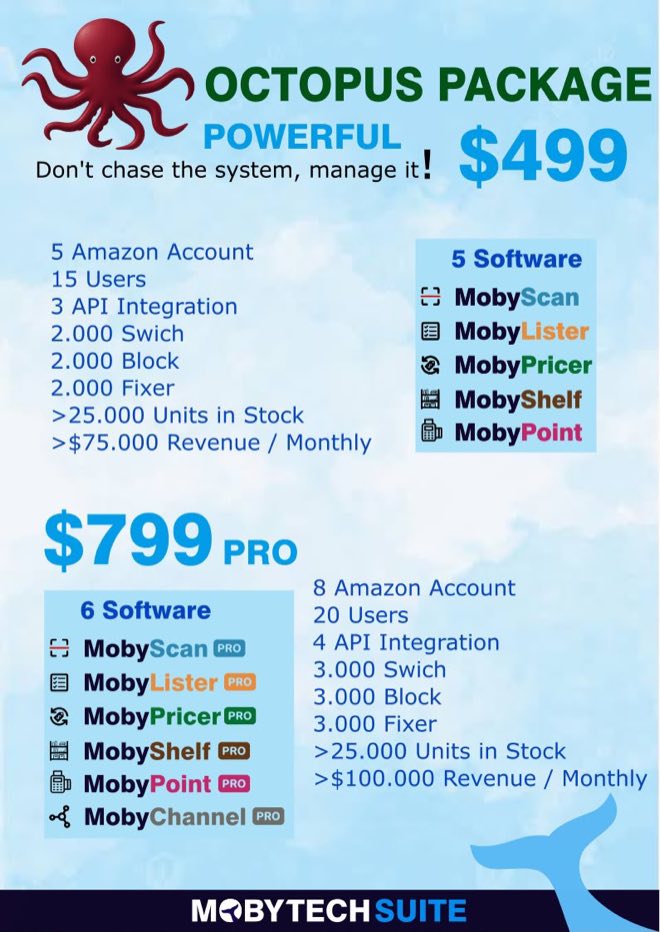
Five Amazon accounts, fifteen people and books that finally balance. Octopus is the plan for an operation with moving parts — and PRO adds a sixth tool that takes your catalogue beyond Amazon alone.
Standard $499/month · PRO $799/month
“Don’t chase the system, manage it!”

Several accounts, a real team, and a month-end that currently involves exporting settlement reports into a spreadsheet and losing a day.
Five storefronts on Standard and eight on PRO — different brands, entities or marketplaces — with one catalogue, one set of rules and one place where the totals already agree.
MobyPoint reconciles every Amazon payout line to the cent and gives you profit and loss per SKU and per marketplace. The month-end that used to eat a day stops eating a day.
On PRO, MobyChannel pushes the same catalogue, stock and prices to your other sales channels — so a second channel stops meaning a second spreadsheet and a nightly reconciliation ritual.
You need every tool we make, unlimited seats or a setup shaped around your own processes rather than ours. That is Whale, and at that size the conversation is about your operation rather than a plan page. Look at Whale instead →
Everything Dolphin runs, plus the two that matter once money and channels multiply: accounting that reconciles itself, and a catalogue that is not tied to one marketplace.
Scan a barcode in the aisle and see landed profit, FBA fees and sales rank before the item goes in your cart.
Turn a UPC or ASIN into a live Amazon listing — condition notes, templates and FNSKU labels included.
Rule-based repricing inside a floor and a ceiling you set. It chases the Buy Box against the seller types you choose and stops rather than selling under your margin.
One stock ledger across warehouses and channels — restock forecasts, ageing stock and stranded inventory surfaced before Amazon tells you.
Seller accounting that reconciles every Amazon payout line to the cent, with profit and loss per SKU and per marketplace.
Push the same catalogue, stock and prices to your other sales channels without keeping a second spreadsheet alive.
Work out what a day of somebody’s month-end costs you, multiply it by twelve, and compare it to the step up from Dolphin. For most operations at this size MobyPoint alone closes that gap — everything else on this page is what you get on top.
The same figures that appear on the printed sheet — nothing rounded up for the website.
| Limit | Standard | PRO |
|---|---|---|
| Amazon hesabı | 5 | 8 |
| Kullanıcı | 15 | 20 |
| Dahil araçlar | Scan · Lister · Pricer · Shelf · Point | + MobyChannel, all PRO grade |
| API connections | 3 | 4 |
| Switch operations | 2,000 | 3,000 |
| Block operations | 2,000 | 3,000 |
| Fixer operations | 2,000 | 3,000 |
| Aylık ciro | $75K | $100K |
| Stok kalemi | 25,000 | 25,000 |
| Phone & email support | ✓ | ✓ |
At this size the interesting unit is not the week — it is the month, and specifically the end of it.
Five accounts, one screen. Yesterday’s sales, the Buy Box share, what is about to run out and what is quietly ageing — across every storefront, without opening five tabs.
Multi-account · MobyShelfFifteen people on Standard and twenty on PRO, each with their own login: sourcers scanning, listers clearing, warehouse staff shipping, all writing into the same catalogue rather than into each other’s spreadsheets.
SeatsOn PRO, MobyChannel keeps your other sales channels stocked and priced from the same catalogue. Adding a channel stops being a project.
MobyChannelAmazon pays out and MobyPoint has already matched it line by line — fees, reimbursements, returns, storage. What used to be a day of exporting and squinting is a report you read.
MobyPointProfit and loss per SKU and per marketplace, exported in a shape your accountant does not send back. You find out which SKUs actually made money this month while it is still useful to know.
MobyPointDon’t chase the system, manage it!
That sentence is printed on the Octopus sheet, and it is the whole argument for this plan. Every limit on this page is taken directly from it.
The export-and-squint ritual at the end of every settlement period, done for you and reconciled to the cent before you open it.
Three more Amazon accounts, five more seats, a fourth API connection, $25K more turnover — and MobyChannel, which is the real reason most operations make the jump.
The same on both tiers, because at this size the thing that scales is accounts, people and channels — not the number of SKUs.
The things sellers ask us before they commit to this plan specifically.
Tell our McKinney, TX team your monthly turnover, SKU count and headcount. Fifteen minutes is usually enough to know whether Octopus is the right size — including when the honest answer is no.
Bizimle konuşun 214 214 MOBYEvery line Amazon puts in a settlement — sales, referral and FBA fees, refunds, reimbursements, storage and advertising deductions — matched against your own cost basis, then rolled up into profit and loss per SKU and per marketplace.
No, and it is not trying to. It ends the data entry and the reconciliation guesswork, and hands your accountant numbers that already balance. What they do with those numbers is still their job.
Three more Amazon accounts, five more seats, one more API connection, $25K more monthly turnover — and MobyChannel, which is PRO only. If you sell on Amazon alone, Standard is very often the right answer.
It is built to keep one catalogue in sync across the other marketplaces and storefronts you sell on. Tell us which ones matter to your business before you buy, and we will confirm exactly what is supported today.
Seats are individual logins rather than a shared password, which is the security answer most teams are looking for at this size. If you need a specific permission structure, raise it with us before you migrate.
They are the automated actions your rules can take. Octopus includes 2,000 of each a month on Standard and 3,000 on PRO. Regularly running the allowance down is the signal to move up rather than a reason for anything to stop.
A plan change, not a rebuild. Your catalogue, cost basis, rules and history stay put; the extra accounts get connected through Amazon’s standard authorisation flow, and MobyPoint starts reconciling from the history already in your account.
All five run on the same Core Suite and the same shared record. What changes is how many Amazon accounts, seats and units you get — and moving between them later costs you nothing but the price difference.

Start your free trial, or tell us your numbers and we will say honestly whether Octopus is the right size.